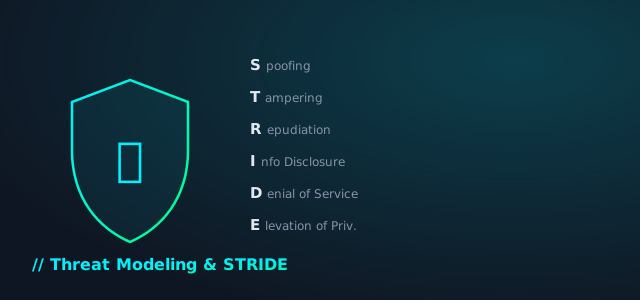
Threat modeling is one of the highest-leverage activities in application security — done well, it catches design flaws before a single line of vulnerable code ships. This is my working reference: how to start, which methodology to reach for, and a deep dive into STRIDE with the edge cases that actually trip people up.
How to Start Threat Modeling
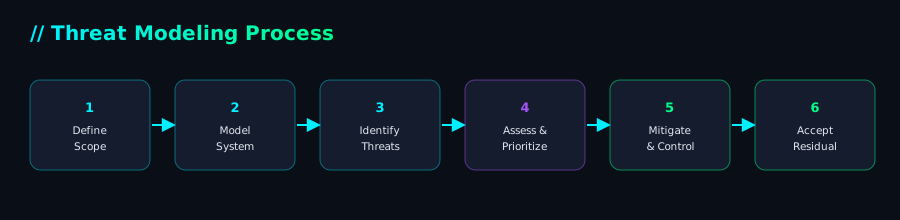
- Define the System Scope
- Identify what you’re protecting (assets, data, functionality)
- Understand the system boundaries
- Document the architecture and data flows
- Create System Models
- Data Flow Diagrams (DFDs)
- Architecture diagrams
- Trust boundaries identification
- Choose Your Methodology
- Based on your context, team expertise, and objectives
- Identify Threats
- Systematically go through each component
- Consider attack vectors and threat actors
- Assess and Prioritize
- Evaluate likelihood and impact
- Prioritize based on risk
- Define Mitigations
- Security controls and countermeasures
- Residual risk acceptance
Threat Modeling Methodologies Comparison
STRIDE (Microsoft)
Best for: Application-level security, systematic coverage Strengths: Comprehensive, well-documented, easy to learn Weaknesses: Can be overwhelming for large systems, doesn’t prioritize by default
PASTA (Process for Attack Simulation and Threat Analysis)
Best for: Risk-centric analysis, business alignment Strengths: Business-focused, considers attacker perspective Weaknesses: More complex, requires more resources
OCTAVE (Operationally Critical Threat, Asset, and Vulnerability Evaluation)
Best for: Organizational risk management Strengths: Asset-focused, considers operational impact Weaknesses: Heavy process, less technical detail
Attack Trees
Best for: Specific attack scenario analysis Strengths: Visual, easy to understand attack paths Weaknesses: Limited scope, doesn’t cover all threat types
STRIDE Methodology Deep Dive
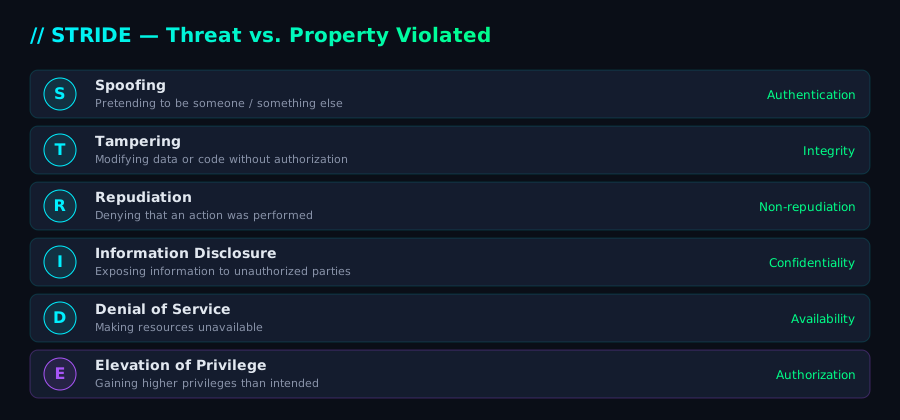
The Six Categories with Edge Cases
1. Spoofing (Identity)
Definition: Pretending to be someone/something else
Clear Examples:
- Using stolen credentials to login
- IP address spoofing
- Email spoofing
- Certificate spoofing
Edge Cases:
- Session hijacking (could be spoofing or tampering)
- Man-in-the-middle attacks (involves both spoofing and tampering)
2. Tampering (Integrity)
Definition: Modifying data or code without authorization
Clear Examples:
- Modifying database records
- Altering configuration files
- Code injection attacks
- Packet modification in transit
Edge Cases:
- Parameter manipulation (could be tampering or elevation of privilege)
- Race conditions leading to data corruption
3. Repudiation (Non-repudiation)
Definition: Denying that an action was performed
Clear Examples:
- User denying they made a transaction
- Admin denying they deleted files
- Lack of audit logs
Edge Cases:
- Shared accounts (makes repudiation easier)
- Clock synchronization issues
4. Information Disclosure (Confidentiality)
Definition: Exposing information to unauthorized parties
Clear Examples:
- SQL injection revealing data
- Directory traversal attacks
- Unencrypted data transmission
- Error messages revealing system info
Edge Cases:
- Timing attacks (information through response times)
- Side-channel attacks
5. Denial of Service (Availability)
Definition: Making resources unavailable
Clear Examples:
- DDoS attacks
- Resource exhaustion
- System crashes
- Network flooding
Edge Cases:
- Algorithmic complexity attacks
- Storage exhaustion through log flooding
6. Elevation of Privilege (Authorization)
Definition: Gaining higher privileges than intended
Clear Examples:
- Buffer overflow leading to admin access
- SQL injection with admin queries
- Privilege escalation bugs
- Insecure direct object references
Edge Cases:
- Horizontal privilege escalation (accessing peer data)
- Time-of-check-time-of-use (TOCTTOU) attacks
10 Examples Clarifying STRIDE Differences
1. Login Page Attack
- Spoofing: Using stolen username/password
- Tampering: Modifying login request to change user role parameter
- Elevation of Privilege: Exploiting a bug that grants admin access after login
2. Database Attack
- Spoofing: Connecting with fake service account credentials
- Tampering: SQL injection modifying user records
- Information Disclosure: SQL injection extracting sensitive data
- Elevation of Privilege: Using SQL injection to execute admin functions
3. API Attack
- Spoofing: Using forged JWT tokens
- Tampering: Modifying API request parameters
- Information Disclosure: Accessing API endpoints without authorization
- Elevation of Privilege: Exploiting IDOR to access admin functions
4. File System Attack
- Spoofing: Impersonating a legitimate process
- Tampering: Modifying configuration files
- Information Disclosure: Reading sensitive files via path traversal
- Elevation of Privilege: Exploiting file permissions to gain root access
5. Network Attack
- Spoofing: ARP spoofing to intercept traffic
- Tampering: Modifying packets in transit
- Information Disclosure: Packet sniffing on unencrypted channels
- Denial of Service: Network flooding
6. Session Management
- Spoofing: Session hijacking with stolen session ID
- Tampering: Modifying session data
- Information Disclosure: Session ID exposure in URLs
- Elevation of Privilege: Session fixation leading to admin access
7. Email System
- Spoofing: Sending emails with forged sender addresses
- Tampering: Modifying email content in transit
- Information Disclosure: Reading others’ emails
- Repudiation: Denying sending malicious emails
8. Web Application
- Spoofing: CSRF attacks impersonating user actions
- Tampering: XSS modifying page content
- Information Disclosure: XSS stealing cookies/tokens
- Elevation of Privilege: XSS leading to admin panel access
9. Mobile Application
- Spoofing: App impersonation through repackaging
- Tampering: Runtime manipulation of app behavior
- Information Disclosure: Insecure data storage
- Elevation of Privilege: Rooting/jailbreaking exploitation
10. Cloud Infrastructure
- Spoofing: Using compromised cloud credentials
- Tampering: Modifying cloud configurations
- Information Disclosure: Misconfigured S3 buckets
- Elevation of Privilege: IAM privilege escalation
A Common Point of Confusion
Scenario: Tampering with login request parameters (like user role)
Analysis:
- Primary Category: Tampering (you’re modifying the request)
- Secondary Effect: Elevation of Privilege (the result is higher access)
- Not Spoofing: You’re not impersonating someone else’s identity
Rule of Thumb: Categorize by the attack method, not the outcome. The outcome helps you understand impact, but STRIDE categorizes the attack vector.
Alternative Threat Modeling Approaches
Once you’re comfortable with STRIDE, these approaches complement it well:
1. PASTA (Recommended Addition)
- More business-risk focused
- Seven-stage process
- Better for executive communication
- Complements STRIDE’s technical focus
2. LINDDUN (For Privacy)
- Privacy-focused threat modeling
- Complements STRIDE for GDPR/privacy requirements
- Seven categories: Linkability, Identifiability, Non-repudiation, Detectability, Disclosure, Unawareness, Non-compliance
3. CVSS + STRIDE
- Use CVSS scoring with STRIDE categories
- Better quantitative risk assessment
- Industry-standard scoring
Threat vs. Risk
A statement I hear often: “A threat is a possible harm/attack to the application, where risk is the overall damage due to that harm or attack.” That’s partially correct, but it’s worth being precise, because the distinction drives how you prioritize.
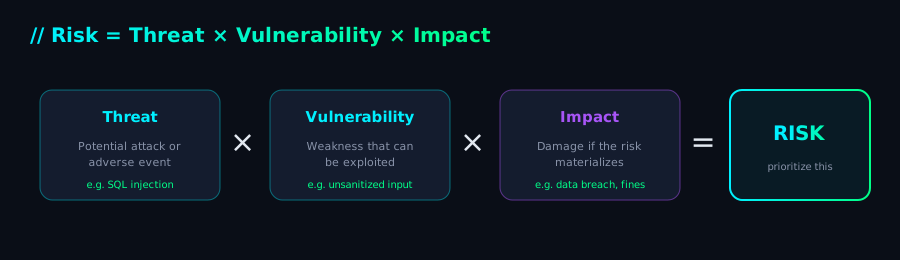
More Precise Definitions:
- Threat: A potential danger or adverse event that could exploit a vulnerability
- Vulnerability: A weakness that can be exploited
- Risk: The potential for loss/damage when a threat exploits a vulnerability
- Impact: The actual damage/consequence if the risk materializes
Formula: Risk = Threat × Vulnerability × Impact
Better Statement: “A threat is a potential attack or adverse event that could exploit system vulnerabilities. Risk is the likelihood of a threat successfully exploiting a vulnerability multiplied by the potential impact/damage.”
Worked Example:
- Threat: SQL injection attack
- Vulnerability: Unsanitized input fields
- Risk: High likelihood of data breach with significant financial/reputational damage
- Impact: Loss of customer data, regulatory fines, reputation damage
This framework is what lets you move from identifying threats (STRIDE) to quantifying and prioritizing risks for business decision-making — which is where threat modeling stops being an academic exercise and starts protecting the product.